

Which Of The Organisms Below Give Support For The Colonial Theory Of Animal Origins
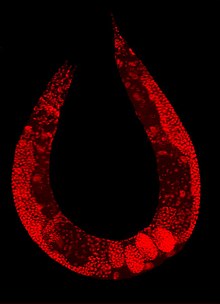
A multicellular organism is an organism that consists of more than i cell, in contrast to a unicellular organism.[1]
All species of animals, land plants and most fungi are multicellular, as are many algae, whereas a few organisms are partially uni- and partially multicellular, like slime molds and social amoebae such as the genus Dictyostelium.[2] [3]
Multicellular organisms arise in various means, for case by jail cell segmentation or by assemblage of many single cells.[4] [3] Colonial organisms are the result of many identical individuals joining together to grade a colony. Nonetheless, it can oft exist hard to separate colonial protists from true multicellular organisms, because the ii concepts are non singled-out; colonial protists have been dubbed "pluricellular" rather than "multicellular".[five] [half-dozen] There are too multinucleate though technically unicellular organisms that are macroscopic, such equally the xenophyophorea that can reach 20 cm.
Evolutionary history [edit]
Occurrence [edit]
Multicellularity has evolved independently at to the lowest degree 25 times in eukaryotes,[seven] [8] and also in some prokaryotes, similar cyanobacteria, myxobacteria, actinomycetes, Magnetoglobus multicellularis or Methanosarcina.[three] However, complex multicellular organisms evolved simply in half-dozen eukaryotic groups: animals, symbiomycotan fungi, brown algae, red algae, green algae, and land plants.[9] Information technology evolved repeatedly for Chloroplastida (green algae and state plants), one time for animals, in one case for dark-brown algae, three times in the fungi (chytrids, ascomycetes and basidiomycetes)[ten] and mayhap several times for slime molds and red algae.[eleven] The commencement testify of multicellular system, which is when unicellular organisms coordinate behaviors and may be an evolutionary precursor to true multicellularity, is from blue-green alga-like organisms that lived 3–3.5 billion years ago.[7] To reproduce, true multicellular organisms must solve the trouble of regenerating a whole organism from germ cells (i.e., sperm and egg cells), an event that is studied in evolutionary developmental biology. Animals have evolved a considerable diverseness of cell types in a multicellular body (100–150 different cell types), compared with x–20 in plants and fungi.[12]
Loss of multicellularity [edit]
Loss of multicellularity occurred in some groups.[xiii] Fungi are predominantly multicellular, though early diverging lineages are largely unicellular (east.g., Microsporidia) and at that place take been numerous reversions to unicellularity across fungi (east.g., Saccharomycotina, Cryptococcus, and other yeasts).[14] [15] It may besides have occurred in some ruby-red algae (e.grand., Porphyridium), but information technology is possible that they are primitively unicellular.[16] Loss of multicellularity is also considered probable in some green algae (eastward.grand., Chlorella vulgaris and some Ulvophyceae).[17] [18] In other groups, more often than not parasites, a reduction of multicellularity occurred, in number or types of cells (e.g., the myxozoans, multicellular organisms, earlier thought to be unicellular, are probably extremely reduced cnidarians).[19]
Cancer [edit]
Multicellular organisms, especially long-living animals, face up the challenge of cancer, which occurs when cells fail to regulate their growth inside the normal program of development. Changes in tissue morphology can be observed during this procedure. Cancer in animals (metazoans) has often been described as a loss of multicellularity.[xx] There is a discussion nigh the possibility of existence of cancer in other multicellular organisms[21] [22] or even in protozoa.[23] For case, establish galls have been characterized as tumors,[24] simply some authors debate that plants do not develop cancer.[25]
Separation of somatic and germ cells [edit]
In some multicellular groups, which are called Weismannists, a separation between a sterile somatic prison cell line and a germ cell line evolved. All the same, Weismannist development is relatively rare (e.thou., vertebrates, arthropods, Volvox), every bit a great office of species accept the chapters for somatic embryogenesis (e.1000., state plants, nigh algae, many invertebrates).[26] [27]
Origin hypotheses [edit]
One hypothesis for the origin of multicellularity is that a group of function-specific cells aggregated into a slug-similar mass called a grex, which moved equally a multicellular unit. This is essentially what slime molds practice. Some other hypothesis is that a primitive cell underwent nucleus division, thereby becoming a coenocyte. A membrane would then grade around each nucleus (and the cellular infinite and organelles occupied in the space), thereby resulting in a group of connected cells in one organism (this mechanism is observable in Drosophila). A third hypothesis is that as a unicellular organism divided, the girl cells failed to separate, resulting in a conglomeration of identical cells in ane organism, which could later on develop specialized tissues. This is what institute and beast embryos do as well as colonial choanoflagellates.[28] [29]
Because the first multicellular organisms were simple, soft organisms lacking bone, shell or other difficult torso parts, they are not well preserved in the fossil tape.[30] 1 exception may be the demosponge, which may have left a chemical signature in aboriginal rocks. The primeval fossils of multicellular organisms include the contested Grypania spiralis and the fossils of the black shales of the Palaeoproterozoic Francevillian Group Fossil B Formation in Gabon (Gabonionta).[31] The Doushantuo Germination has yielded 600 one thousand thousand year quondam microfossils with prove of multicellular traits.[32]
Until recently, phylogenetic reconstruction has been through anatomical (particularly embryological) similarities. This is inexact, equally living multicellular organisms such equally animals and plants are more than 500 meg years removed from their single-cell ancestors. Such a passage of time allows both divergent and convergent evolution time to mimic similarities and accrue differences between groups of modernistic and extinct ancestral species. Mod phylogenetics uses sophisticated techniques such every bit alloenzymes, satellite Dna and other molecular markers to describe traits that are shared betwixt distantly related lineages.[ commendation needed ]
The development of multicellularity could take occurred in a number of different means, some of which are described below:
The symbiotic theory [edit]
This theory suggests that the first multicellular organisms occurred from symbiosis (cooperation) of different species of single-cell organisms, each with dissimilar roles. Over time these organisms would become so dependent on each other they would non exist able to survive independently, somewhen leading to the incorporation of their genomes into one multicellular organism.[33] Each respective organism would become a split up lineage of differentiated cells within the newly created species.
This kind of severely co-dependent symbiosis tin be seen frequently, such every bit in the relationship betwixt clown fish and Riterri sea anemones. In these cases, it is extremely doubtful whether either species would survive very long if the other became extinct. Even so, the problem with this theory is that information technology is still not known how each organism's DNA could be incorporated into 1 unmarried genome to institute them as a single species. Although such symbiosis is theorized to accept occurred (e.k., mitochondria and chloroplasts in animal and plant cells—endosymbiosis), it has happened only extremely rarely and, even then, the genomes of the endosymbionts have retained an element of distinction, separately replicating their Dna during mitosis of the host species. For instance, the two or three symbiotic organisms forming the composite lichen, although dependent on each other for survival, have to separately reproduce and and so re-form to create one individual organism once more.
The cellularization (syncytial) theory [edit]
This theory states that a single unicellular organism, with multiple nuclei, could accept adult internal membrane partitions around each of its nuclei.[34] Many protists such as the ciliates or slime molds can have several nuclei, lending support to this hypothesis. However, the simple presence of multiple nuclei is non enough to support the theory. Multiple nuclei of ciliates are dissimilar and have clear differentiated functions. The macronucleus serves the organism's needs, whereas the micronucleus is used for sexual reproduction with exchange of genetic material. Slime molds syncitia form from individual amoeboid cells, similar syncitial tissues of some multicellular organisms, non the other fashion round. To be deemed valid, this theory needs a demonstrable case and mechanism of generation of a multicellular organism from a pre-existing syncytium.
The colonial theory [edit]
The colonial theory of Haeckel, 1874, proposes that the symbiosis of many organisms of the same species (unlike the symbiotic theory, which suggests the symbiosis of different species) led to a multicellular organism. At least some, information technology is presumed land-evolved, multicellularity occurs by cells separating and then rejoining (e.g., cellular slime molds) whereas for the majority of multicellular types (those that evolved within aquatic environments), multicellularity occurs every bit a upshot of cells failing to divide following segmentation.[35] The mechanism of this latter colony germination can exist as simple as incomplete cytokinesis, though multicellularity is also typically considered to involve cellular differentiation.[36]
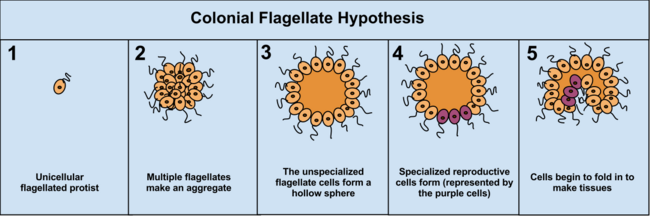
The advantage of the Colonial Theory hypothesis is that information technology has been seen to occur independently in 16 different protoctistan phyla. For instance, during food shortages the amoeba Dictyostelium groups together in a colony that moves every bit 1 to a new location. Some of these amoeba so slightly differentiate from each other. Other examples of colonial organization in protista are Volvocaceae, such every bit Eudorina and Volvox, the latter of which consists of upwards to 500–50,000 cells (depending on the species), merely a fraction of which reproduce.[37] For example, in one species 25–35 cells reproduce, eight asexually and around 15–25 sexually. Yet, it can often exist hard to separate colonial protists from true multicellular organisms, as the two concepts are not distinct; colonial protists have been dubbed "pluricellular" rather than "multicellular".[5]
The synzoospore theory [edit]
Some authors suggest that the origin of multicellularity, at to the lowest degree in Metazoa, occurred due to a transition from temporal to spatial cell differentiation, rather than through a gradual development of prison cell differentiation, as affirmed in Haeckel's gastraea theory.[38]
GK-PID [edit]
About 800 one thousand thousand years ago,[39] a minor genetic change in a single molecule called guanylate kinase poly peptide-interaction domain (GK-PID) may have allowed organisms to go from a single prison cell organism to one of many cells.[40]
The office of viruses [edit]
Genes borrowed from viruses and mobile genetic elements (MGEs) have recently been identified as playing a crucial role in the differentiation of multicellular tissues and organs and fifty-fifty in sexual reproduction, in the fusion of egg cell and sperm.[41] [42] Such fused cells are too involved in metazoan membranes such equally those that prevent chemicals crossing the placenta and the encephalon body separation.[41] Two viral components have been identified. The start is syncytin, which came from a virus.[43] The 2d identified in 2007 is called EFF1, which helps class the skin of Caenorhabditis elegans, part of a whole family unit of FF proteins. Felix Rey, of the Pasteur Institute in Paris has constructed the 3D structure of the EFF1 poly peptide[44] and shown it does the work of linking one prison cell to another, in viral infections. The fact that all known cell fusion molecules are viral in origin suggests that they have been vitally of import to the inter-cellular communication systems that enabled multicellularity. Without the ability of cellular fusion, colonies could have formed, only anything even as complex every bit a sponge would not have been possible.[45]
Oxygen availability hypothesis [edit]
This theory suggests that the oxygen available in the atmosphere of early Earth could take been the limiting factor for the emergence of multicellular life.[46] This hypothesis is based on the correlation between the emergence of multicellular life and the increase of oxygen levels during this fourth dimension. This would take taken place afterwards the Smashing Oxidation Upshot but before the most recent rising in oxygen. Mills[47] concludes that the amount of oxygen present during the Ediacaran is not necessary for complex life and therefore is unlikely to accept been the driving cistron for the origin of multicellularity.
Snowball Earth hypothesis [edit]
A snowball World is a geological result where the unabridged surface of the Globe is covered in snowfall and ice. The most recent snowball Earth took place during the Cryogenian menstruum and consisted of 2 global glaciation events known as the Sturtian and Marinoan glaciations. Xiao[48] suggests that between the menses of time known as the "Boring Billion" and the snowball Globe, simple life could have had time to innovate and evolve which could afterwards lead to the evolution of multicellularity. The snowball Earth hypothesis in regards to multicellularity proposes that the Cryogenian menses in Earth history could have been the catalyst for the development of complex multicellular life. Brocks[49] suggests that the fourth dimension between the Sturtian Glacian and the more than recent Marinoan Glacian allowed for planktonic algae to boss the seas making style for rapid diversity of life for both plant and animate being lineages. Shortly subsequently the Marinoan, complex life quickly emerged and diversified in what is known as the Cambrian explosion.
Predation hypothesis [edit]
The predation hypothesis suggests that in order to avoid being eaten by predators, elementary unmarried-celled organisms evolved multicellularity to arrive harder to be consumed as prey. Herron et al.[50] performed laboratory development experiments on the single-celled dark-green alga, Chlamydomonas reinhardtii, using paramecium every bit a predator. They found that in the presence of this predator, C. reinhardtii does indeed evolve elementary multicellular features.
Advantages [edit]
Multicellularity allows an organism to exceed the size limits normally imposed by improvidence: single cells with increased size accept a decreased surface-to-volume ratio and have difficulty absorbing sufficient nutrients and transporting them throughout the prison cell. Multicellular organisms thus take the competitive advantages of an increase in size without its limitations. They can have longer lifespans as they tin can go along living when private cells dice. Multicellularity besides permits increasing complexity by allowing differentiation of cell types inside 1 organism.
Whether these tin can be seen equally advantages however is debatable. The vast bulk of living organisms are single cellular, and fifty-fifty in terms of biomass, single cellular organisms are far more successful than animals, though not plants.[51] Rather than seeing traits such equally longer lifespans and greater size as an advantage, many biologists come across these just as examples of diversity, with associated tradeoffs.
Encounter also [edit]
- Bacterial colony
- Embryogenesis
- Organogenesis
- Unicellular organism
References [edit]
- ^ Becker, Wayne M.; et al. (2008). The world of the cell. Pearson Benjamin Cummings. p. 480. ISBN978-0-321-55418-five.
- ^ Chimileski, Scott; Kolter, Roberto (2017). Life at the Edge of Sight: A Photographic Exploration of the Microbial Earth. Harvard University Press. ISBN9780674975910.
- ^ a b c Lyons, Nicholas A.; Kolter, Roberto (April 2015). "On the evolution of bacterial multicellularity". Current Stance in Microbiology. 24: 21–28. doi:10.1016/j.mib.2014.12.007. ISSN 1879-0364. PMC4380822. PMID 25597443.
- ^ Southward. Thousand. Miller (2010). "Volvox, Chlamydomonas, and the evolution of multicellularity". Nature Education. 3 (9): 65.
- ^ a b Brian Keith Hall; Benedikt Hallgrímsson; Monroe W. Strickberger (2008). Strickberger's evolution: the integration of genes, organisms and populations (4th ed.). Hall/Hallgrímsson. p. 149. ISBN978-0-7637-0066-ix.
- ^ Adl, Sina; et al. (October 2005). "The New Higher Level Classification of Eukaryotes with Emphasis on the Taxonomy of Protists". J. Eukaryot. Microbiol. 52 (5): 399–451. doi:x.1111/j.1550-7408.2005.00053.x. PMID 16248873. S2CID 8060916.
- ^ a b Grosberg, RK; Strathmann, RR (2007). "The evolution of multicellularity: A minor major transition?" (PDF). Annu Rev Ecol Evol Syst. 38: 621–654. doi:10.1146/annurev.ecolsys.36.102403.114735.
- ^ Parfrey, Fifty.W.; Lahr, D.J.Chiliad. (2013). "Multicellularity arose several times in the evolution of eukaryotes" (PDF). BioEssays. 35 (4): 339–347. doi:10.1002/bies.201200143. PMID 23315654. S2CID 13872783.
- ^ http://public.wsu.edu/~lange-thousand/Documnets/Teaching2011/Popper2011.pdf[ bare URL PDF ]
- ^ Niklas, KJ (2014). "The evolutionary-developmental origins of multicellularity". Am. J. Bot. 101 (1): 6–25. doi:10.3732/ajb.1300314. PMID 24363320.
- ^ Bonner, John Tyler (1998). "The Origins of Multicellularity" (PDF). Integrative Biology. 1 (ane): 27–36. doi:ten.1002/(SICI)1520-6602(1998)1:1<27::Assistance-INBI4>iii.0.CO;ii-6. ISSN 1093-4391. Archived from the original on March 8, 2012.
{{cite journal}}: CS1 maint: unfit URL (link) - ^ Margulis, L. & Chapman, Grand.J. (2009). Kingdoms and Domains: An Illustrated Guide to the Phyla of Life on Earth ([4th ed.]. ed.). Amsterdam: Academic Printing/Elsevier. p. 116.
- ^ Seravin L. N. (2001) The principle of counter-directional morphological development and its significance for constructing the megasystem of protists and other eukaryotes. Protistology two: 6–xiv, [1].
- ^ Parfrey, L.W. & Lahr, D.J.One thousand. (2013), p. 344.
- ^ Medina, Chiliad.; Collins, A. G.; Taylor, J. W.; Valentine, J. W.; Lipps, J. H.; Zettler, 50. A. Amaral; Sogin, One thousand. L. (2003). "Phylogeny of Opisthokonta and the evolution of multicellularity and complexity in Fungi and Metazoa". International Journal of Astrobiology. 2 (3): 203–211. Bibcode:2003IJAsB...2..203M. doi:10.1017/s1473550403001551.
- ^ Seckbach, Joseph, Chapman, David J. [eds.]. (2010). Cerise algae in the genomic age. New York, NY, United states of americaA.: Springer, p. 252, [2].
- ^ Cocquyt, Eastward.; Verbruggen, H.; Leliaert, F.; De Clerck, O. (2010). "Evolution and Cytological Diversification of the Light-green Seaweeds (Ulvophyceae)". Mol. Biol. Evol. 27 (ix): 2052–2061. doi:ten.1093/molbev/msq091. ISSN 0737-4038. PMID 20368268.
- ^ Richter, Daniel Joseph: The gene content of diverse choanoflagellates illuminates animal origins, 2013.
- ^ "Myxozoa". tolweb.org . Retrieved 14 April 2018.
- ^ Davies, P. C. W.; Lineweaver, C. H. (2011). "Cancer tumors as Metazoa 1.0: borer genes of ancient ancestors". Physical Biology. 8 (1): 015001. Bibcode:2011PhBio...8a5001D. doi:ten.1088/1478-3975/eight/ane/015001. PMC3148211. PMID 21301065.
- ^ Richter, D. J. (2013), p. 11.
- ^ Gaspar, T.; Hagege, D.; Kevers, C.; Penel, C.; Crèvecoeur, G.; Engelmann, I.; Greppin, H.; Foidart, J. M. (1991). "When plant teratomas turn into cancers in the absence of pathogens". Physiologia Plantarum. 83 (iv): 696–701. doi:ten.1111/j.1399-3054.1991.tb02489.10.
- ^ Lauckner, G. (1980). Diseases of protozoa. In: Diseases of Marine Animals. Kinne, O. (ed.). Vol. 1, p. 84, John Wiley & Sons, Chichester, United kingdom of great britain and northern ireland.
- ^ Riker, A. J. (1958). "Found tumors: Introduction". Proceedings of the National University of Sciences of the United States of America. 44 (4): 338–9. Bibcode:1958PNAS...44..338R. doi:10.1073/pnas.44.4.338. PMC335422. PMID 16590201.
- ^ Doonan, J.; Hunt, T. (1996). "Cell cycle. Why don't plants get cancer?". Nature. 380 (6574): 481–2. doi:10.1038/380481a0. PMID 8606760. S2CID 4318184.
- ^ Ridley M (2004) Evolution, 3rd edition. Blackwell Publishing, p. 295-297.
- ^ Niklas, Chiliad. J. (2014) The evolutionary-developmental origins of multicellularity.
- ^ Fairclough, Stephen R.; Dayel, Mark J.; King, Nicole (26 October 2010). "Multicellular development in a choanoflagellate". Current Biology. 20 (twenty): R875–R876. doi:x.1016/j.cub.2010.09.014. PMC2978077. PMID 20971426.
- ^ In a Single-Prison cell Predator, Clues to the Brute Kingdom'south Nascence
- ^ A H Knoll, 2003. Life on a Young Planet. Princeton University Press. ISBN 0-691-00978-3 (hardcover), ISBN 0-691-12029-three (paperback). An first-class book on the early history of life, very accessible to the not-specialist; includes extensive discussions of early signatures, fossilization, and system of life.
- ^ El Albani, Abderrazak; et al. (1 July 2010). "Large colonial organisms with coordinated growth in oxygenated environments 2.1 Gyr ago". Nature. 466 (7302): 100–104. Bibcode:2010Natur.466..100A. doi:10.1038/nature09166. ISSN 0028-0836. PMID 20596019. S2CID 4331375.
- ^ Chen, L.; Xiao, South.; Pang, K.; Zhou, C.; Yuan, X. (2014). "Cell differentiation and germ–soma separation in Ediacaran beast embryo-similar fossils". Nature. 516 (7530): 238–241. Bibcode:2014Natur.516..238C. doi:x.1038/nature13766. PMID 25252979. S2CID 4448316.
- ^ Margulis, Lynn (1998). Symbiotic Planet: A New Look at Evolution. New York: Basic Books. p. 160. ISBN978-0-465-07272-9.
- ^ Hickman CP, Hickman FM (8 July 1974). Integrated Principles of Zoology (fifth ed.). Mosby. p. 112. ISBN978-0-8016-2184-0.
- ^ Wolpert, L.; Szathmáry, East. (2002). "Multicellularity: Evolution and the egg". Nature. 420 (6917): 745. Bibcode:2002Natur.420..745W. doi:ten.1038/420745a. PMID 12490925. S2CID 4385008.
- ^ Kirk, D. Fifty. (2005). "A twelve-footstep program for evolving multicellularity and a division of labor". BioEssays. 27 (3): 299–310. doi:ten.1002/bies.20197. PMID 15714559.
- ^ AlgaeBase. Volvox Linnaeus, 1758: 820.
- ^ Mikhailov K. V., Konstantinova A. V., Nikitin Thou. A., Troshin P. V., Rusin Fifty., Lyubetsky Five., Panchin Y., Mylnikov A. P., Moroz L. 50., Kumar S. & Aleoshin V. 5. (2009). The origin of Metazoa: a transition from temporal to spatial prison cell differentiation. Bioessays, 31(seven), 758–768, [3] Archived 2016-03-05 at the Wayback Automobile.
- ^ Erwin, Douglas H. (ix November 2015). "Early metazoan life: divergence, surround and ecology". Phil. Trans. R. Soc. B. 370 (20150036): 20150036. doi:10.1098/rstb.2015.0036. PMC4650120. PMID 26554036.
- ^ Zimmer, Carl (7 January 2016). "Genetic Flip Helped Organisms Go From I Jail cell to Many". New York Times . Retrieved vii January 2016.
- ^ a b Eugene Five. Koonin: Viruses and mobile elements as drivers of evolutionary transitions. In: Philos Trans R Soc Lond B Biol Sci., 2016 Aug 19, doi:10.1098/rstb.2015.0442
- ^ Rafi Letzter: An Ancient Virus May Be Responsible for Human Consciousness, in: Live Science, February 02, 2018
- ^ Mi S1, Lee 10, Li X, Veldman GM, Finnerty H, Racie L, LaVallie E, Tang XY, Edouard P, Howes S, Keith JC Jr, McCoy JM.: Syncytin is a convict retroviral envelope protein involved in human being placental morphogenesis. In: Nature. 2000 Feb 17;403(6771):785-789. doi:10.1038/35001608, PMID 10693809
- ^ Jamin, M, H Raveh-Barak, B Podbilewicz, FA Rey et al. (2014) "Structural basis of eukaryotic prison cell-cell fusion" (Prison cell, Volume 157, Event two, 10 April 2014), Pages 407–419, doi:10.1016/j.cell.2014.02.020
- ^ Slezak, Michael (2016), "No Viruses? No skin or basic either" (New Scientist, No. 2958, 1 March 2014) p.16
- ^ Nursall, J. R. (April 1959). "Oxygen as a Prerequisite to the Origin of the Metazoa". Nature. 183 (4669): 1170–1172. Bibcode:1959Natur.183.1170N. doi:10.1038/1831170b0. ISSN 1476-4687. S2CID 4200584.
- ^ Mills, D. B.; Ward, L. M.; Jones, C.; Sweeten, B.; Forth, M.; Treusch, A. H.; Canfield, D. E. (2014-02-18). "Oxygen requirements of the earliest animals". Proceedings of the National Academy of Sciences. 111 (11): 4168–4172. Bibcode:2014PNAS..111.4168M. doi:10.1073/pnas.1400547111. ISSN 0027-8424. PMC3964089. PMID 24550467.
- ^ Lyons, Timothy W.; Droser, Mary L.; Lau, Kimberly V.; Porter, Susannah M.; Xiao, Shuhai; Tang, Qing (2018-09-28). "After the tiresome billion and earlier the freezing millions: evolutionary patterns and innovations in the Tonian Catamenia". Emerging Topics in Life Sciences. 2 (ii): 161–171. doi:ten.1042/ETLS20170165. hdl:10919/86820. ISSN 2397-8554. PMID 32412616.
- ^ Brocks, Jochen J.; Jarrett, Bister J. G.; Sirantoine, Eva; Hallmann, Christian; Hoshino, Yosuke; Liyanage, Tharika (August 2017). "The rise of algae in Cryogenian oceans and the emergence of animals". Nature. 548 (7669): 578–581. Bibcode:2017Natur.548..578B. doi:10.1038/nature23457. ISSN 1476-4687. PMID 28813409. S2CID 205258987.
- ^ Herron, Matthew D.; Borin, Joshua M.; Boswell, Jacob C.; Walker, Jillian; Chen, I.-Chen Kimberly; Knox, Charles A.; Boyd, Margrethe; Rosenzweig, Frank; Ratcliff, William C. (2019-02-20). "De novo origins of multicellularity in response to predation". Scientific Reports. ix (one): 2328. Bibcode:2019NatSR...9.2328H. doi:10.1038/s41598-019-39558-8. ISSN 2045-2322. PMC6382799. PMID 30787483.
- ^ Bar-On, Yinon Grand.; Phillips, Rob; Milo, Ron (2018-06-nineteen). "The biomass distribution on World". PNAS. 115 (25): 6506–6511. doi:x.1073/pnas.1711842115. PMC6016768. PMID 29784790.
External links [edit]
- Tree of Life Eukaryotes
Source: https://en.wikipedia.org/wiki/Multicellular_organism
Posted by: harrisseatomint.blogspot.com
0 Response to "Which Of The Organisms Below Give Support For The Colonial Theory Of Animal Origins"
Post a Comment